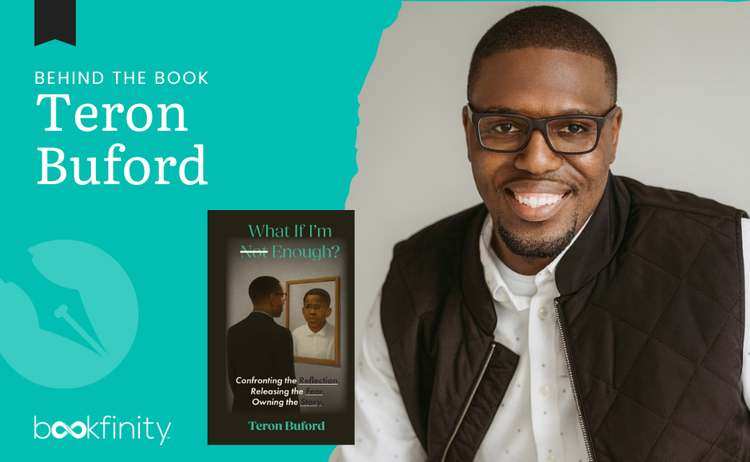
teron buford on the connective power of storytelling
Teron Buford is an author, storyteller, and founder of GRACE through SOUL, a company that helps people and organizations unlock the power of identity and lived experience. His core belief is simple and human: your story isn’t a shackle, it’s the key. Raised in circumstances that demanded resilience, Teron’s journey moves from survival to service, reflection, and authenticity. Through his memoir, What If I’m Enough?, he invites people to see that progress, not perfection, is what shapes healing and growth. Whether he’s speaking, mentoring, or supporting community and organizational work, Teron brings honesty, humor, and compassion to every space, helping others honor their stories and believe that who they are has always been enough.
What If I'm Enough?: Confronting the Reflection. Releasing the Fear. Owning the Story.
by Teron Buford
What If I'm Enough? is a deeply honest memoir about what it means to confront your own reflection-both the literal and the metaphorical-and discover that the person staring back is worth believing in.
Told with unflinching vulnerability, sarcastic humor, and a storyteller's rhythm, Teron invites readers into a life shaped by love, loss, resolve, and the constant search for true self. From the complexities of being born into trauma and struggling to find balance while navigating spaces that rarely understood his personhood, to the tenderness and turbulence of family relationships, to seasons of deep grief and self-doubt, Teron doesn't shy away from the messy middle of becoming.
Each chapter is a window into moments that molded him: the uncle who shaped his sense of manhood, the lessons learned in homelessness and hardship, the balancing act of being a young husband and father, and the quiet (and sometimes loud) conversations about identity, mental health, and masculinity. Along the way, the unsung heroes of his story-the ones who scolded, loved, lifted, and looked out for him-emerge as proof that community, even with all its flaws, is often what carries us through.
Teron's story is an invitation to see the beauty in the imperfect, the courage in the vulnerable, and the power in owning your story, even the parts you once tried to hide.
With a voice that's both deeply personal and widely relatable, Teron reminds us that self-worth is rarely found in the approval of others but built in the quiet moments of truth-telling, in the choice to keep showing up, and in the audacity to believe that who you are is already enough.
Interview with teron buford:
How does it feel to be a first-time author and have your work be received so well - and even awarded by IndieReader?
If I’m being fully honest, I’m still learning how to receive it. Don’t get me wrong: receiving the award… it’s nice to have my story and experience be recognized, but I didn’t write this chasing confirmation, validation, or praise. But that affirmation is humbling… and strange. But it’s also encouraging. It’s a reminder to anybody who is reading along at this point that they’re not navigating this life alone, and if we’re having an experience, you can be sure that there’s probably somebody else out there who can relate to it.
Your book navigates heavy topics with humor weaved in. Was that balance intentional from the beginning, or did your natural storytelling voice just take over in that way?
Humor is how I have survived all the hard things in my life. That balance that you feel inside of the book comes from my actual voice and lived experience. I’m naturally this silly, lighthearted kind of guy because, deep down, I think we all need some sort of mechanism that helps us rebound after hardship. I’m of the belief that “heavy” doesn’t have to mean “humorless.” And I think sometimes laughter can create room for truth, authenticity, and being real in a way that matters. I was hoping that I could convey that to the reader and give them a breath between some of the challenges because that’s what life’s all about: challenge, rebound, and getting back to it. So that’s probably what you’re feeling when you see my sense of humor show up.
Writing a memoir can be incredibly vulnerable and emotional. How did you decide which parts of your life to include and which to leave out? Was there a chapter or story that was particularly difficult to write out?
I tried to be intentional to include stories that told a larger truth together. Not every single painful detail needed to be on every other page inside of the book. And it was important for me to recognize that some of the stories and experiences that I had that were the most influential to me also belong to other people. So I needed to be thoughtful about putting their stories out into the world, especially if they weren’t ready for that. For me, I guess some of the hardest parts about writing the book were also some of the most honest and cathartic ones. Talking about moments of feast and famine from my childhood. Or the love and loss that accompanies friends and family members moving or passing away. Or the tragedy, but also sometimes triumph, that comes with living for today but being thoughtful about tomorrow and not losing sight of the learnings of yesterday while simultaneously not allowing them to paralyze you in the moment today. And that’s a lot to try to manage. There’s no easy way to write about any of that without practicing some level of discernment, but also courageous vulnerability.
You write about confronting your reflection, both literally and metaphorically. Did you discover anything about yourself that surprised you through the writing process of this book?
The biggest thing I realized is that fear had been leading my life for a really long time. As I wrote the book, I started to see these patterns emerge that I had normalized and allowed to take root. Trying to become the person that others expected me to be at the sacrifice of who I actually was was killing me. I had these misconceptions about mental health, masculinity, strength, and stewardship. I had this idea of what I was supposed to be, and it was flawed, and through the writing process, I think I was able to unlock three key elements. The first one is that love, real love, isn’t conditioned on my performance, output, or how much I can do for someone or give to something. Real love just cares about itself. Love cares about love, and that’s all it wants to do. Writing also exposed, for me, this mask that I had been wearing. Honestly, I should’ve outgrown it years before I decided to take it off, but that just wasn’t the case. It took me going through some challenges to see that that mask was doing way more harm than good. Lastly, and in alignment with the book, was that when you boil it all down and at the end of the day, I am enough. I’m more than what I believe myself to be. I was enough. And in learning that, I was liberated from this bondage I had created that primarily existed between my ears. But once I knew it, and I understood the narrative, it was easier for me to counter it. And that’s probably the biggest takeaway from this entire writing process.
Your book touches on grief, mental health, masculinity, family, belonging, and purpose. Why did identity become the thread that connected all of those experiences?
Identity was underneath every single wound. Every single story of my life. I think about the grief that I experienced and how that changed who I thought I was and who I wanted to be. Or how I thought about masculinity and how it shaped what I allowed myself to feel and think about my existence as a man. Or how belonging questioned where I could show up fully. And from all of that, purpose emerged after I stopped performing what I thought “worth” was supposed to be. All that came together and told a story of the reflection of who I was yesterday, established the person that I am today, and helped lay the groundwork for the person I might become tomorrow. And I think that’s one of the truest and most raw forms of living into identity. So yes, that is how identity ends up becoming the throughline across all those dimensions.
You discuss masculinity in a thoughtful way. What conversations about manhood do you think we're still avoiding? What advice would you give young men who believe vulnerability makes them weak?
Masculinity is such a hard topic to talk about. I can’t tell you how many times I’ve heard stories of men who believe that they can’t be vulnerable and how that has led to internalized pain, isolation, self-harm, or worse. And then it gets compounded by this narrative about how hard it is to be a man because the system that’s in place forces us into the most dangerous jobs, armed services, to be protectors, providers, the rock, unbreakable and unshakable. And after a while, it’s not hard to experience all of that as an unimpeachable truth. But there’s another part of the truth that we don’t talk about. That’s that we, as men, have created the system and those norms that perpetuate our very own hurt. We, men, made it soft to talk about your feelings. We made it weak to not want to be an alpha male. We made it OK to keep things bottled up on the inside. We still avoid men’s fears and tenderness. We mistake vulnerability for weakness or a flaw that presents itself as exposure. Many of us are fed the steady stream of “you have to perform before you can be a person” or that “your performance is tied to your personhood.” But here’s the dirty little secret: strength without honesty and openness almost always leads to isolation. Vulnerability is not a weakness; it’s access. Knowing that you need help, having shortfalls and having the courage to name it, taking time to do the inner work to build oneself up… Dammit, if that’s not one of the most masculine pursuits of all, I don’t really know what it is. Full stop. Period.
As a storyteller, why do you think stories have the power to reach people and effect change in a way that other mediums don’t?
Stories bypass just about any defense that you can think of. People will resist your advice, your feedback, your criticism, hell, they will resist your encouragement if they don’t believe it’s coming from a valid place. But we recognize ourselves in stories. Stories make the complicated and abstract experiences of love, life, and pain human. They make it so that we can create a connection before we ever have to go down the path of critique. And a lot of times, that’s where change starts: when people can feel seen. And stories are the platform for that. They allow us to have those genuine connections to each other while also giving us permission to close the gap between things that we think we know and maybe some of the things that we don’t. It makes it OK to have an experience in your life and know that you’re not the only one who’s gone through it. Someone else has probably lived it too. There’s not a single vehicle out there that I’ve seen, heard, or experienced that does a better job of connecting those dots than storytelling.
If readers walk away remembering only one lesson from your stories, what do you hope it is?
Fear lies loudly, but truth comes in a whisper. Fear will scream at you that you are your worst moment, but truth will whisper that you just had a bad day. Fear might argue that your story owns you, but the soft voice of truth will remind you that you own the story. So, I think it’s important that you don’t hide away from the challenges of your past simply because they were hard, challenging to deal with, or make you uncomfortable. Because fear will oftentimes proclaim that your story is a shackle, but the truth of the matter is that it’s actually the key. So you have to do everything you can in your power, everything in your ability, to reject the lie that fear wants you to believe.
Tell us about Grace Through Soul and your experience working with people through your company.
GRACE through SOUL is actually an acronym. It stands for “Grounded Reflections and Centered Experiences Through Stories Of Uncovering Life.” And it’s the heartbeat of the book. It’s a company that I started that leads development work from a person centered, identity centered frame. I help people turn reflection into growth, and that work lives between the intersections of identity and impact. We have these learning experiences together that help create honest rooms, get us away from polished performances, and push us toward a better understanding of self, value, worth, and what that means for “better.” It doesn’t matter if it’s a one-on-one conversation, classroom discussion, team workshop, or conference keynote: I work with individuals, groups, organizations, and companies to harness the power of personal identity to help unlock the potential that’s oftentimes guarded behind a door of insecurity.
What are you most excited to be working toward right now?
Each day I’m trying to learn how to be a better husband, father, man, and citizen. I look around at what my wife and I have built together, and I can’t help but smile in amazement. Not because of any materialistic thing that we’ve collected, but because of the values we’ve been able to create. The cycles of childhood trauma and abuse that my kids don’t, and hopefully won’t, have to experience. The joy and wonderment I see in them, not worrying about things that kids shouldn’t have to worry about in the first place. Or the fact that I don’t have to fall into the same cycles of ownership, misuse, abuse, apology, and makeup with my wife (the person I love more than anybody else in this world… self included), and I become terrifyingly excited to keep walking down this path to see what life has in store for me. For us. And I’m also excited about how this work has begun to expand. This book has opened doors for me in ways that I could’ve never expected. Building trust and fortitude around the concepts of identity and being OK with your personhood. Yourself. It feels like that’s a natural next chapter in my life (pun intended). I’m just looking forward to going down that road and seeing what those conversations evolve into. But I’m also doing my best to not get too far ahead of myself and trying to be present for every moment day in and day out.
And more!
Check out Teron's powerful, award-winning memoir on courage, healing, and self-worth: What If I'm Enough?: Confronting the Reflection. Releasing the Fear. Owning the Story.
Check out Teron's website for more information on his work and his organization GRACE through SOUL!
Ready to share your own story like Teron? Start publishing your memoir with IngramSpark today!