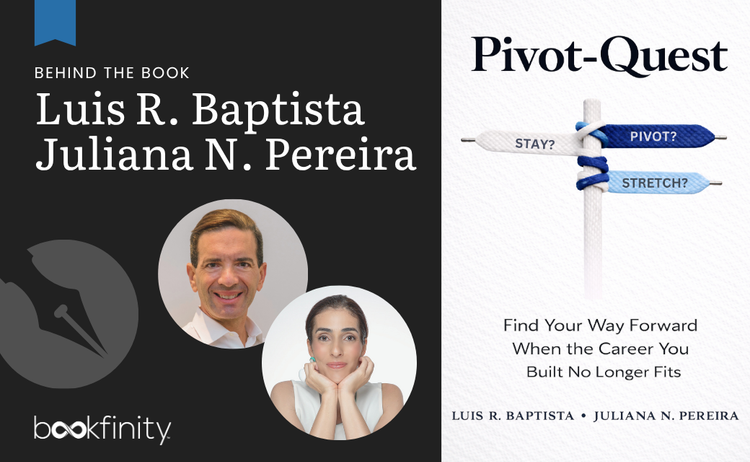
the pivot-quest authors on pivoting and publishing in partnership
Luis R. Baptista has held more job titles than most people have hobbies. He began at Procter & Gamble, pivoted to AT&T, led Chicco in Venezuela, brought Cinnabon to continental Europe, teaches at IE Business School, and his online course on Coursera has reached more than 140,000 learners. That's the short list. Civil engineer, marketer, product developer, retail manager, business developer, consultant, strategist, researcher, entrepreneur. Often several at once, across three continents. In a world that rewards specialists, he was told that being a generalist was a weakness. Turns out, it was his superpower. Every pivot taught him something the last one couldn't: how to learn fast, adapt faster, and connect dots nobody else could see.
Juliana N. Pereira has spent her life crossing borders, between cultures, countries, careers, and communities. Raised between Colombian, Portuguese, and American worlds, she learned early that belonging isn't something we find. It's something we build. Her eight career pivots have taken her from advertising at BBDO and product design to luxury fashion PR for Gucci, Burberry, and Tiffany & Co.; from developing world-class retail experiences to founding and successfully exiting a wellness venture; from building community for more than 10,000 students from over 160 nationalities at IE University to serving as Global CMO of an international technology consultancy.
Pivot-Quest: Find Your Way Forward When the Career You Built No Longer Fits
by Luis R Baptista - Juliana N Pereira
"We spent three years listening. Over a hundred people in 25 countries told us their real pivot stories- not the LinkedIn version. The messy, terrifying, honest version. We also talked to experts such as psychologists, behavioral scientists, financial planners, AI experts, personal branding specialists, and we built a framework. Not theory. Not 'follow your passion.' A practical, four-phase process: Discover, Define, Shape, Test." - Luis R. Baptista and Juliana N. Pereira
The world of work is evolving at unprecedented speed. AI, automation, and shifting industries are redefining career stability, leaving many professionals uncertain about what comes next.
Pivot-Quest is a practical, research-backed guide to navigating career change with clarity and confidence.
Drawing from their own multiple international career pivots and extensive research with successful career pivoters, Luis R. Baptista and Juliana N. Pereira present a structured, step-by-step framework for reinvention. This is not theory or motivation alone. It is a clear blueprint designed to reduce risk, manage uncertainty, and help you move forward strategically.
Inside, you will learn how to assess your current position, identify transferable strengths, design a transition plan aligned with future workforce demands, and build momentum without burning out.
If you are actively seeking change or preparing for disruption, Pivot-Quest offers a proven path to reset your career with purpose and direction.
Start your career reset with strategy, not guesswork.
Interview with luis r. baptista & juliana n. pereira:
Tell us about the creative process of writing this book in partnership. How did you decide to write it, and what was it like working together to conduct research and craft this narrative?
Luis R. Baptista: This book began with a personal emergency, not a publishing plan. When I sold my last businesses, I knew the career I had built was over. I gave myself three months for self-discovery. I took 67 assessments. I read 16 books on career pivots. I hired two very expensive coaching programs. Three months later, I had a mountain of data and nowhere to go. An engineer and consultant who could listen to thousands of client data points, synthesize them, and generate insights could not do it for himself. Why had my earlier pivots felt natural, and this one felt like drowning?
Here is what I eventually understood. It was not that self-discovery is impossible. It was that I had no method. Every assessment told me what I was like. None of them told me what to do on Monday. Every book was written for someone changing jobs. I was not changing jobs. I was rebuilding a life that no longer fit. So I started building the process I could not find. That became a platform for career pivoting, and I spent some years testing the theory behind it. For the first year I ran it alone: two quantitative studies and two rounds of qualitative research, checking whether the patterns I thought I was seeing were real.
Then I asked Juliana to join me, because she was going through her own transition, and because nobody should pivot alone. From there we split the fieldwork between us: pivoters, experts, university career offices, and companies. The book was not the plan. Two things changed that. It became clear that finding product-market fit would take longer than I had thought, and large language models had arrived, and I was fairly sure they would take some people’s jobs before my product could reach them. So I wrote the method down. Juliana found the stories. We wrote twenty-six chapters and a workbook. Chapter 6, Your Preflight Checklist, is the assessment I wish someone had handed me on day one.
We are opposites, which is the point: I go deep and structured, she goes wide and fast and refuses to let a page be boring. Years of arguing about what was true, and the book is better for it. She has her own version of this story, and she tells it herself, in her own words rather than mine.
 After interviewing more than 100 career pivoters around the world, what surprised you most?
Juliana N. Pereira: The biggest surprise wasn't how different people's careers were, it was how similar their emotional journeys were. We interviewed founders, teachers, doctors, executives, entrepreneurs, artists, engineers, people in their twenties and people reinventing themselves in their sixties. We spoke to people across more than twenty-five countries, expecting culture or profession to shape their experiences in completely different ways.
Instead, we kept hearing the same questions.
"Am I too late?"
"What if I fail?"
"Will people think I've wasted my career?"
"Who am I if I'm no longer this title?"
That realization changed everything for me. It made me understand that career reinvention isn't really a professional challenge, it's a deeply human one. That's why I often say that a career pivot isn't a career event, it's a life event. And perhaps the most hopeful discovery was this: no matter where people lived or what they did, the ones who navigated change most successfully had one thing in common. They didn't try to do it alone.
Is there a case study that has stayed with you the longest, and what is it about it that resonated so strongly?
LRB: I will share two brief stories from our generous interviewees.
The first is a charity-sector professional, back at her desk after maternity leave and quietly certain she was in the wrong life. She was one of the first people I interviewed, in August 2023, before there was any idea of a book. She was good at her job. That was part of the problem. “I’m great at my current job, but it doesn’t make me happy.” “I feel like a square peg in a round hole.” And the line I have not forgotten: “If I left tomorrow, within a week I wouldn’t care, and worst, nobody would care.” Then she told me something that changed the course of the research. She had not told her spouse or friends. Not one. She had decided she did not want other people’s opinions in her head. She had no mentor either, because everyone who could mentor her was already in the career she was trying to leave. She was doing the hardest thing of her adult life entirely alone, on purpose.
Most of our serial career pivoters went through their journeys alone. She was the one who made me see it was often a choice, not a fact. Successful journeys can happen on your own, but they are more enjoyable, and even quicker, with a support group. She opened my eyes to a new phase of investigation. We talk about it in Chapter 14, Finding Your Hive, and Cheat Code 2, Support System.
The second is a serial pivoter, and what makes him unusual is that every single time, he moved before he had to. In the book, he is Daniel, in Chapter 3.
He was a nuclear physicist. Three degrees. Then Chernobyl ended the funding for his field, and within months he went from the frontier of physics to standing in front of office workers, teaching them how to add up a column in a spreadsheet. We asked him to rate his passion for his work in that period, out of ten. He said two. “It was more a spirit of survival,” he told us. “Trying to find my place in the world.”
From there into technology, then more than a decade at one company, rising into senior leadership. And then he left. Nothing was wrong. His company had never looked stronger; every number on his desk was green, and he walked into a firm almost nobody had heard of. He left because he had been talking to customers, and they had quietly stopped wanting to buy the way his company sold. “There wasn’t any sign of any downhill,” he told us. “But it was clear that it wasn’t going to last.” He calls it the golden cage. Nothing is wrong. You wake up, and everything is the same. And you know. He had developed the ability to stay alert and adapt, and he was willing to put in the time to always be ahead of the curve.
What’s the career advice you most strongly disagree with today, and why?
JNP: "Never leave a secure job." In today's world, I think that's becoming increasingly outdated. The World Economic Forum estimates that nearly 40% of workers' core skills will change within the next five years. Stability no longer comes from staying in the same job. It comes from remaining adaptable. For me, the best career advice today is much simpler. Adaptability, fueled by curiosity. That is the combination that the data cannot replicate. Because curiosity is what keeps us learning, connecting, experimenting, and discovering opportunities we never knew existed. Curiosity keeps identity flexible. It keeps possibility alive. In many ways, I think curiosity has become one of the most important career skills of the twenty-first century.
 How do you know whether you’re facing temporary burnout versus a genuine signal that it’s time to pivot?
LRB: Great question. We discuss it in Chapter 24, "Reading the Signals." Throughout the book, we include Golden Nuggets, amazing lessons we’ve heard people say that apply to the different steps in the journey. One from a pivoter that applies in this situation is, “The forces of taking energy to do something need to be stronger than staying where you are. That’s the law of nature, we preserve energy.”
Without giving away the stories and exercises in the chapter, from personal experience, burnout feels completely different. It means being constantly tired and drained, irritated, and ruminating constantly about something related to your job. On the other hand, we heard about many types of pivoting signals. For example, feeling unfulfilled, asking yourself if this is all there is, evaluating whether you truly want your boss’s job, going through confusion and a sort of crisis of confidence, feeling lost, and feeling that it is not fun or enjoyable most of the time. Some people also wanted to pivot because of different kinds of signals, such as wanting to use more of their brain, creativity or challenge, or feeling bored.
What do you think people are still misunderstanding about AI’s impact on careers? And what human skill do you believe will matter most in the age of AI?
JNP: I think we're spending too much time asking which jobs AI will replace and not enough time asking what becomes more valuable because AI exists. Technology has always transformed work. AI is simply accelerating that change. AI is scrambling career paths. Career transitions depend on existing skills. AI changes these skills. Which changes possible career paths. Effective transitions happen by mapping existing skills, identifying adjacent roles and building on the missing skills. What won't change is our need for people who can build trust, navigate uncertainty, ask thoughtful questions, connect ideas, exercise judgment, and create meaningful relationships.
Throughout our research, I became increasingly convinced that our humanity is no longer a nice-to-have. It's becoming our competitive advantage. We have become remarkably good at teaching people how to choose a path. We spend far less time teaching them how to navigate change. How to pivot. How to hold an identity through uncertainty. That is the skill gap nobody is measuring. Curious people don't see change as the end of their story. They see it as the beginning of a new chapter. In a world changing this quickly, I believe curiosity is no longer simply a personality trait.
It's a survival strategy.
If there is one idea you hope readers remember years after finishing Pivot-Quest, what would it be?
LRB: A pivot does not start with a new job. It starts with an honest sentence. The first step is always smaller than people think. Almost nobody we interviewed pivoted because a plan told them to. They pivoted because something no longer fit, and then they needed to do something about it. You do not need a new career. You need a next chapter.
And more!
Thinking about a career pivot? Don't navigate it alone. Learn from people who've made the journey and use a practical framework to turn uncertainty into your next step with Pivot-Quest: Find Your Way Forward When the Career You Built No Longer Fits
Check out the Pivot-Quest website for more information, and follow Luis and Juliana on Instagram to stay in the loop with their work!
Ready to share your wisdom with the world like Luis and Juliana? Start publishing your book with IngramSpark today!